
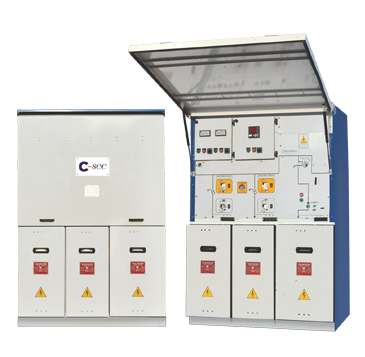
A C-sec 4-way Ring Main Unit (RMU) is a compact, factory-assembled, medium-voltage switchgear used in electrical power distribution networks, manufactured by C-sec Technologies. The “4-way” configuration indicates it has four functional compartments or ways for cable connections, typically two for incoming/outgoing ring switches and two for outgoing transformer feeders.
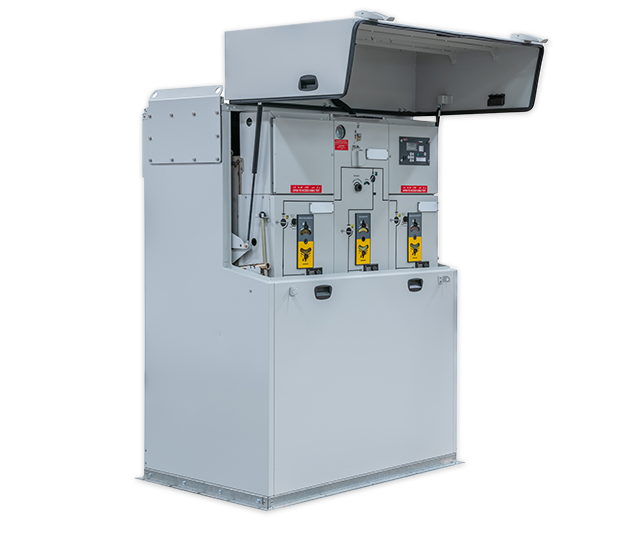
Key Features
- Insulation: It is an SF₆ gas-insulated switchgear, with all live parts sealed for life in a hermetically sealed stainless steel tank, making it insensitive to environmental conditions such as dirt, moisture, and high humidity.
- Components: A typical 4-way unit might include two load break switches (LBS) for the main ring circuit and two circuit breakers (CB) for transformer protection (LBS-CB-CB-LBS configuration).
- Protection: The circuit breaker feeders are equipped with protection relays (e.g., non-directional O/C and E/F protection) to guard against overload, short-circuit faults, and ground-fault currents.
- Safety & Interlocking: It features extensive mechanical and electrical interlocking systems to prevent incorrect operation and ensure personnel safety. The design prevents access to live parts during operation without specific tools.
- Operation: It can be operated manually or can be motorized for remote control and monitoring via SCADA (Supervisory Control and Data Acquisition) systems and Remote Terminal Units (RTUs) for smart grid applications.
- Standards: C-sec RMUs are developed according to international standards, such as IEC 62271-200.
- Durability: The unit is designed for a long, maintenance-free life (more than 40 years) with a very low gas leakage rate.
Functionality & Application
- Ring Redundancy: The ring configuration, utilizing the two ring switches, allows power to be supplied from an alternative feeder in case of a fault in one section, ensuring an uninterrupted power supply to connected loads.
- Fault Isolation: In the event of a fault (e.g., a transformer fault), the relevant circuit breaker trips, and the switches on either side of the fault can be opened to isolate the problem area, while the rest of the network continues to receive power.
- Applications: They are widely used in urban areas, residential blocks, high-rise buildings, factories, and commercial centers to enhance network reliability and uptime.